
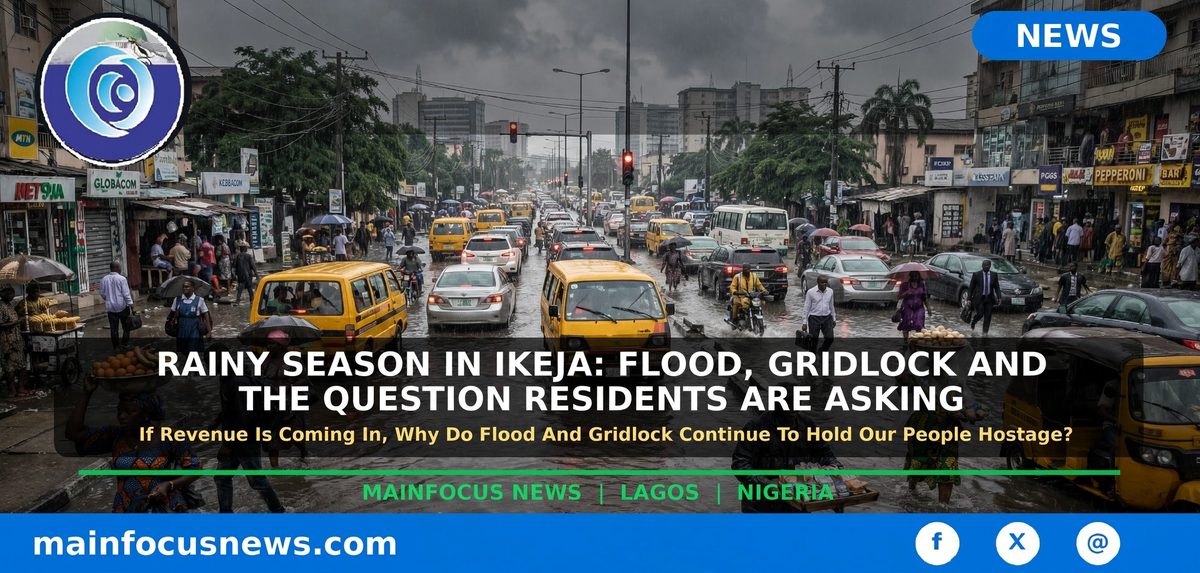
Every rainy season, the same story repeats itself in Ikeja.
A 30-minute rainfall is enough to turn Oba Akran Road into a river. Ikeja Along becomes a parking lot. Traders in Computer Village struggle to protect their goods. Drivers spend two to three hours on a journey that should take 15 minutes.
This is not a new story. It is the story of Ikeja every year.
And Ikeja is not a poor Local Government. Ikeja is the capital of Lagos State. Ikeja generates Internally Generated Revenue, IGR, daily from markets, businesses, Computer Village, hotels, banks, and companies.
Therefore, the question residents are asking is simple:
If revenue is coming in, why do flood and gridlock continue to hold our people hostage every rainy season?
What Residents Are Experiencing
- Oba Akran Road, Flooding When it rains, blocked drainage forces water onto the road. Cars stop. Motorcycles cannot pass. Workers heading to the Alausa Secretariat wade through water.
- Ikeja Along, Airport Road, Gridlock One breakdown, one fallen tree, or one blocked canal is enough to lock up the entire corridor. There is no rapid team to tow, patch, and redirect within hours. People miss flights, miss work, and miss hospital appointments.
- Anifowoshe and Surrounding Canals, Blocked Drainage Desilting is often not done before the rains. When the rain comes, the water has nowhere to go. It enters houses and shops.
- Computer Village, Fire and Safety Risk One of the busiest markets in West Africa. Yet exposed cables, blocked access roads, and the absence of a clear rapid response plan remain a serious risk during peak hours.
These are not political issues. They are daily life issues.
What Ikeja Residents Want
We are not asking for magic. We are asking for three simple things:
- A Rapid Response Desk. One number, one WhatsApp line, one USSD code where a resident can report blocked drainage, a breakdown, or an exposed transformer, and receive a response within hours, not weeks. 2. A 72-Hour Rule. If a hazard is reported today, it should be cordoned off today, receive a temporary fix tomorrow, and the permanent fix should commence within 72 hours. If this is not met, the reason should be explained to the public. 3. A Public Report. Every month, Ikeja Local Government should publish how many cases were received, how many were resolved, and how long they took. Transparency will build trust.
That is all. Speed without chaos. Coordination without red tape.
The Call
We are calling on all stakeholders in Ikeja, Community Development Associations, market leaders in Computer Village, youth groups, churches, mosques, transport unions, and business owners in Allen, Opebi, GRA, and Ojodu, to speak with one voice:
Let us fix Ikeja together.
Ikeja deserves a system that works during rain, during traffic, and during emergencies, not only during campaigns.
In Part 2 of this series, we will present a practical 72-hour framework that can work with existing staff, existing vehicles, and existing assets of Ikeja Local Government, without waiting for a new budget cycle.
Ikeja residents are tired of suffering for problems that can be solved.
Your voice matters. If you have a photo or video of flood or gridlock in your area in Ikeja, send it to MainFocus. We will publish it.
Fisayo Fakayode, Publisher, MainFocus News



Leave a Reply